Peptides
6-week bpc-157 and tb-500 stack dosing, the Wolverine stack
A practical, evidence-forward protocol for the *bpc-157 and tb-500 stack dosing* people ask about, mechanisms, timelines, and realistic risks.

If you searched for bpc-157 and tb-500 stack dosing, this article gives a clear, clinically minded plan you can use or discuss with a provider. I cover a 6-week starter protocol, the mechanisms behind each peptide, expected timelines for healing, realistic risks, and what to do if something goes sideways. This is for clinicians and experienced peptide users who want practical guidance, not hype.
Quick answer: what the Wolverine stack is and why people use it
The phrase Wolverine stack is shorthand for combining bpc-157 with tb-500 to speed soft-tissue repair and reduce inflammation after tendinous, ligament, or muscle injury. Both peptides are small proteins with complementary mechanisms of action: bpc-157 is gastric-derived and appears to modulate angiogenesis and fibroblast behavior, while tb-500 is a fragment related to thymosin beta-4 that encourages cell migration and actin remodeling. The intent is faster structural repair and improved mobility, not cosmetic changes.
If you want the short practical point, here it is: a 6-week co-treatment with conservative dosing gives a predictable window to observe clinical benefit. Use conservative initiation to assess tolerability, monitor a clear functional endpoint, and have a plan to stop. Frankly, that last part matters more than any microgram tweak.
Mechanisms explained, briefly and clinically
You need to know how each peptide helps so your dosing choices make sense. BPC-157 seems to upregulate VEGF and nitric oxide signaling, promoting capillary growth and local perfusion in animal models. That increases nutrient delivery and can blunt early inflammatory damage, which is why you may see functional gains in the first 2, 7 days in animal studies. See broad literature aggregated on BPC-157 on PubMed for animal and limited human reports.
TB-500 works by binding actin and modulating cell motility. The cell-migration effect helps fibroblasts and endothelial cells move into the injured zone, encouraging matrix remodeling. In practice, TB-500 is often described as improving range of motion and reducing tissue stiffness over 1, 4 weeks. For mechanistic reviews of thymosin beta-4 biology, see the PubMed collection linked below.
- bpc-157: promotes angiogenesis and local perfusion
- tb-500: promotes actin remodeling and cell migration
- combined: aims to couple blood supply with cellular remodeling
Mechanistic synergy is plausible. Angiogenesis without migration leaves poorly organized tissue. Migration without blood starves the repair process. That's why many clinicians pair the two. But most data are from animal models and small case reports, so label benefits as preliminary when advising patients.
Safety and evidence: what the literature actually says
The evidence base for the Wolverine stack is limited. BPC-157 and TB-500 have supportive animal data for tendon, ligament, and gut healing, and scattered human case reports. There are no large randomized controlled trials in humans, and regulatory oversight is minimal. Use the precautionary principle when dosing off-label compounds.
Known safety signals are modest in animal work, mainly local irritation and transient systemic changes. The major risks in the clinic are contamination, improper injection technique, and off-target, undocumented effects. Keep injections sterile, keep dosing conservative, and have a baseline safety screen with CBC, CMP, and a focused vascular history when using systemic dosing.
If you want a credible primer on wound biology and why these mechanisms matter, read a review on wound healing physiology from the NIH library. That context helps you understand timing windows for angiogenesis and matrix remodeling, which in turn shapes our dosing schedule.
How clinicians dose the stack, sample 6-week protocol
Below is a practical 6-week protocol many experienced clinicians use as a starting point for a focal tendon or muscle injury. This is not medical advice. Have an experienced prescriber monitor you. The protocol is conservative and emphasizes early evaluation points.
- Week 0, evaluation: confirm diagnosis with imaging if needed, baseline labs (CBC, CMP), informed consent, plan for re-eval at 2 weeks.
- Weeks 1, 2, initiation: bpc-157 200 mcg subcutaneous once daily near the injury site, tb-500 2 mg subcutaneous twice weekly (e.g., Mon/Thu). Monitor pain and ROM daily.
- Weeks 3, 4, consolidation: if improved, reduce bpc-157 to 200 mcg every other day, continue tb-500 2 mg once weekly. Add progressive rehab and functional milestones.
- Weeks 5, 6, taper and reassess: stop bpc-157 after week 6 if functional goals met, maintain tb-500 2 mg once weekly for a total of 6 weeks if needed, otherwise discontinue. Final functional and lab recheck at end.
The per-dose ranges you see here reflect common clinical practice: bpc-157 100, 500 mcg daily is widely used, but many start at 200 mcg. TB-500 induction ranges 2, 5 mg per week split across days, with common regimens using 2 mg twice weekly for 2, 4 weeks then tapering. Those ranges are based on practitioner reports and animal-to-human scaling, not RCTs.
Injection technique and practical tips
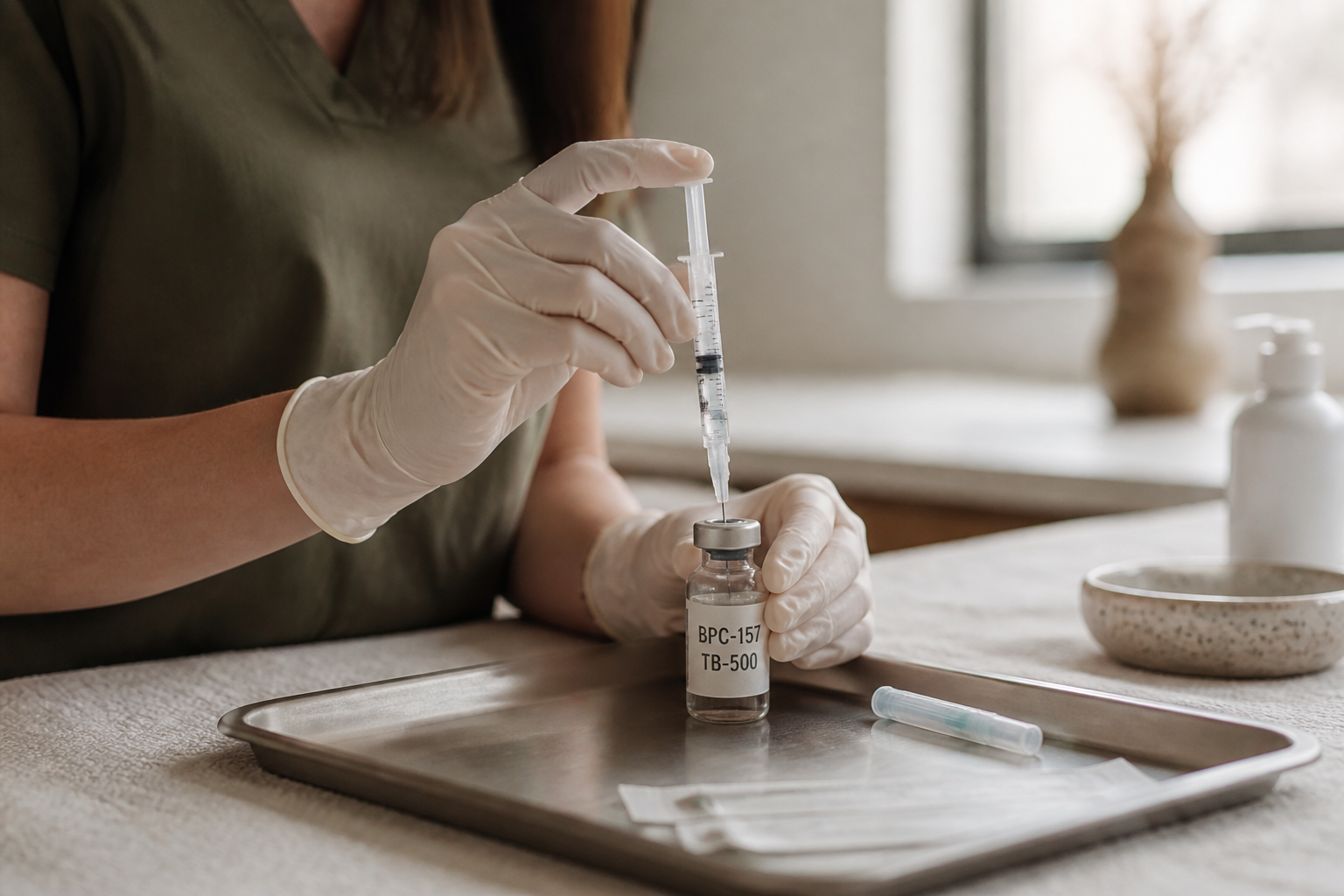
Injection technique matters more than tiny dose differences. Use subcutaneous local injection within 1, 2 cm of the injured area to maximize local exposure when treating tendons or superficial muscle. For deeper structures, discuss ultrasound-guided delivery with a clinician. Keep everything sterile and use single-use syringes and swabs.
- site prep: alcohol swab, let dry, avoid touching the site again
- needle size: 29, 31 gauge for subcutaneous dosing to reduce pain
- storage: refrigerated vials in a dedicated cooler during travel
Not clickbait, refrigeration and handling affect peptide stability. Reconstitute as instructed by the lab, use bacteriostatic water if advised, and discard any multi-dose vial after recommended time. The biggest safety gains come from clean technique and verified sourcing.
Expected timeline of effects and how to measure success
Have a measurement plan before starting. Typical milestones clinicians observe are: reduced pain and inflammation in 2, 10 days, improved range of motion in 1, 4 weeks, and structural changes on imaging if followed for 6, 12 weeks. Functional improvement is the primary endpoint in practice.
Use objective measures when possible: goniometry, timed function tests, and strength measures are more reliable than subjective pain scores alone. If imaging is important for your case, plan baseline ultrasound or MRI and repeat at 6, 12 weeks to assess tissue architecture changes.
Based on pooled clinical experience and animal data
Common side effects, drug interactions, and red flags
Most users report mild local irritation, transient headaches, or slight systemic fatigue. Serious events are rare in the literature, but unknown long-term effects are the principal safety concern. Avoid concurrent unmonitored use of anticoagulants or immunosuppressants during induction unless supervised.
- local reaction: redness or small lump at injection site, usually self-limited
- systemic: mild fatigue, headache; stop if fever or systemic illness occurs
- red flag: sudden increased pain, swelling, or drainage, seek urgent care
If you take blood pressure medication or have vascular disease, consult a clinician. BPC-157 influences nitric oxide and vascular tone in animal studies. That could interact with medications that affect vascular function.
Comparing protocols and personalization
There is no single best protocol. The right regimen depends on injury size, depth, patient age, comorbidities, and goals. Older patients or those with slower healing may benefit from a longer consolidation phase. Athletes who need faster return may accept a more aggressive induction, but that increases monitoring needs.
| Use case | Typical induction | Maintenance/taper |
|---|---|---|
| **acute tendon tear (partial)** | **bpc-157 200 mcg daily, tb-500 2 mg twice weekly** for 2 weeks | **bpc-157 every other day, tb-500 2 mg weekly for 4 weeks** |
| **chronic tendinopathy** | **bpc-157 200 mcg daily for 2 weeks** then reassess | **tb-500 2 mg weekly for 6 weeks** with focused rehab |
| **muscle strain, athletic return** | **bpc-157 100, 200 mcg daily short course** and **tb-500 2 mg twice weekly** | **stop after functional restoration, typically 4, 6 weeks** |
Personalize the volume and location of injections. For superficial injuries, multiple adjacent subcutaneous spots spaced 1 cm apart increase local exposure. For deeper tendons, an ultrasound-guided peritendinous approach is cleaner and concentrates dose where you want it.
"In my practice the biggest mistake is starting too many therapies at once. Start the stack alone, measure function, then layer other interventions."
— PuraGene clinician
Stopping rules and how to taper safely
Have predefined stopping criteria before you begin. Common rules include stopping if pain increases >30% from baseline for 72 hours, any signs of infection, or new unexplained systemic symptoms. If you stop, expect any gains to regress partially over 2, 6 weeks depending on rehab fidelity.
Tapering is simple: drop the more frequent agent first. For the Wolverine stack we typically stop bpc-157 first and maintain low-frequency tb-500 for another 2, 4 weeks if structural remodeling still seems active. This mirrors the idea that perfusion support is front-loaded while remodeling continues later.
Case examples and realistic expectations
Example 1, a middle-aged runner with chronic Achilles tendinopathy: after 6 weeks on the stack plus targeted eccentric loading, pain decreased and running tolerance improved from 10 to 30 minutes. Imaging showed modest tendon thickening. Functional gains were the focus, not perfect imaging normalization.
Example 2, a 28-year-old sprinter with grade 2 hamstring strain: on a shorter 4-week induction, they reported early pain drop in 5 days and returned to limited sprinting at week 3 with progressive loading. The clinician used ultrasound guidance and strict return-to-play criteria.
- realistic goal: improved function and reduced pain, not instant structural 'fix'
- timeline: expect early subjective gains, objective structural changes take longer
- rehab essential: peptides are adjuncts to progressive loading

Common mistakes and how to avoid them
Common errors come from poor selection, poor technique, and poor monitoring. Overdosing early because you think more is better is a frequent mistake. Start conservative and escalate only if there's clear benefit and no adverse signals.
- mistake: using multiple unproven adjuncts simultaneously
- mistake: skipping baseline labs and imaging
- mistake: sourcing from unknown vendors without batch verification
What to actually do, step-by-step
Here is exactly what I tell patients who ask for the Wolverine stack. Follow it or discuss with your clinician: get baseline labs, confirm imaging, pick a 6-week window with low schedule stress, start conservative dosing, document function, and schedule check-ins at 2 and 6 weeks.
- Step 1: baseline tests and informed consent, include CBC and CMP and targeted imaging
- Step 2: source GMP-grade peptides, confirm storage and COA
- Step 3: start the 6-week protocol (see sample dosing above), keep a daily log
- Step 4: reassess at 2 weeks. If no benefit and any adverse effects, stop
- Step 5: continue to 6 weeks if improving, taper as described, continue rehab
If you’re trying to get back to high-level sport, build objective return-to-play gates into this plan. Don’t rely only on pain.
The takeaways
- 6-week starter is a common clinical window to judge benefit
- 200 mcg bpc-157 daily induction is a conservative starting dose
- 2 mg tb-500 twice weekly induction is commonly used, then taper
- monitor at 2 weeks and stop if symptoms worsen
- sterile sourcing and injection technique are primary safety levers
Common questions
Below are short answers to the most frequent questions I hear, with practical next steps and what to watch for. Keep a 2-week reassess as your safety anchor.
Sources & further reading

About the writer
Research Writer, Peptides & Metabolic Health
Marcus covers the peptide and GLP-1 beat for the Journal. He has spent years reading through compounding formularies, FDA guidance documents, and clinical write-ups so he can explain what the labels actually mean in plain English. He is a writer and researcher, not a pharmacist or prescriber.
Frequently asked
- Is the bpc-157 and tb-500 stack safe long term?
- Long-term safety is uncertain. Short courses of 4, 8 weeks are widely reported in practice with relatively few serious short-term adverse events, but there are no strong long-term human trials. Use conservative regimens, monitor labs, and avoid indefinite unsupervised use.
- Can I inject the peptides into the tendon itself?
- Direct intratendinous injections should be done only under imaging guidance by an experienced clinician. Peritendinous subcutaneous injections near the injury are the common safer approach in outpatient settings. Ultrasound guidance improves accuracy and reduces off-target risk.
- What if I don’t see improvement after two weeks?
- If there is no clinical signal by two weeks, stop the peptides and re-evaluate diagnosis and rehab strategy. Continuing an ineffective therapy increases cost and exposure without benefit. Consider imaging or a specialist consult.
- Can peptides replace physical therapy?
- No. Peptides are adjuncts, not replacements. Progressive loading and targeted rehab remain the primary drivers of durable tendon and muscle recovery. Use peptides to support those processes when appropriate.
- Where can I read more primary literature?
- Start with curated searches on PubMed for BPC-157 and thymosin beta-4, and read wound-healing reviews from the NIH to understand timing and biology. The Cleveland Clinic also has practical guidance on wound-care principles that inform safe practice.